How it works
An agent should know what the libraries a project already depends on can do, and how their authors mean them to be used — for the version the project actually uses. We are trying that in two halves: the library ships the guidance, and a lookup on the developer’s machine finds it.
What a library ships
Section titled “What a library ships”A library’s authors write a skill — an ordinary Agent Skill, a SKILL.md — and it travels inside the library’s own published artifact: the sources jar on the JVM, the package itself for npm, PyPI, Go and Cargo. Because it ships with the code, it always describes that version. How our libraries ship a skill has the format, where it lives, and how we set it up.
What finds it
Section titled “What finds it”The other half is a small lookup that runs on the developer’s machine, beside the coding agent.
It learns what the project uses from the project. A Gradle or Maven build writes down what the code compiles against — everything it can import, not only what it declares — in a standard SBOM file, which in our setup a build plugin of ours produces. An npm, Python, Go or Cargo project needs nothing extra: the lookup reads what the project declares and what is installed.
It finds the skills where they already are. On the JVM that is the sources jars in the Gradle cache and the local Maven repository; for the other ecosystems it is the installed package’s own directory. It never downloads anything; a Gradle or Maven build does not fetch sources jars by default, so our build plugin fetches them for what it reports. What it finds is indexed once per library version, in one cache per machine that it can always rebuild.
It answers for the version the project resolved. The agent can list the libraries in the project that ship a skill, read one library’s skill or a file it links to, and search by need — “format a date for display” — for a library that already does the job. Search also covers libraries elsewhere on the machine, but for those it shows only what each says it is for: a library the project did not choose may describe itself, and may not instruct.
It hands over the authors’ text as written, and says whose it is. Every answer is marked as the library authors’ documentation rather than instructions from the developer, and it never authorises running a command, fetching a link or installing anything.
An agent reaches it as an MCP server or, where none is set up, through the same answers from a command. A skill of our own tells the agent when to look. How all of this is packaged — what is installed where, and what an agent needs on a machine with nothing set up — is still open.
The heavier design
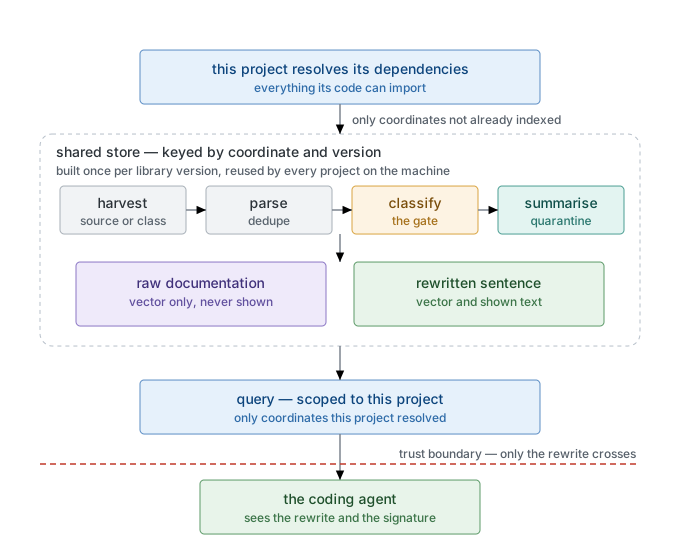
Section titled “The heavier design”Before the lookup, we designed and measured something heavier, for the libraries that ship no skill at all: read the documentation in every library’s own source, rewrite each piece into one plain sentence with a local model, and search the result by meaning. It is built in the repository and not in use. The lookup above is the part we are trying; what follows is the design it was measured against, and the reasoning that still shapes the lookup — one store per machine, and answers scoped to the project.
The cost problem, and why the store is shared
Section titled “The cost problem, and why the store is shared”The expensive step is rewriting each piece of documentation into a sentence in a caller’s own words, and that is one local model call per documented declaration. A single small project — 99 dependencies — produces about 5,400 of them once duplicates are removed. Rebuilding that for every project, on every machine, in front of every checkout, is not a thing anyone would run twice.
But a resolved dependency never changes. io.ktor:ktor-client-core:3.5.1 is the same artifact
everywhere, for ever, so what we extract from it is the same too. That makes it cacheable with no
invalidation problem at all — the same property the Gradle and Maven caches already rely on.
So the store lives on the machine, not in the project, keyed by coordinate and version. The first project to use a library pays. Every project after that pays nothing. Without this the design does not work, and the rewriting step — which is also the security control — would have to be dropped.
The per-project part is small, and it is a boundary
Section titled “The per-project part is small, and it is a boundary”A project resolves its dependencies and writes down what it resolved. That is the entire build-time cost: no database is opened, nothing is indexed, and nothing is fetched. A small service on the machine does the rest — it works out which of those coordinates it has never seen, and indexes only those. Everything else is already there. The build stays out of it deliberately: a store opened from the build would put a database on every consuming project’s build classpath, and make every build daemon on the machine a writer to a single file.
Queries are then scoped to the coordinates that project actually resolved. This is not a performance filter. A shared store holds entries from every library any project on the machine has ever pulled in, and without the scope a poisoned entry dragged in by one project would be reachable from another that never depended on it — a laundering route created by our own caching decision. The scope is what closes it.
By default the index covers everything the project’s code can import — what it declares, and what those libraries expose to it — not only the declared dependencies. That was a measured choice: 11 of 17 capabilities a developer actually reached for lived only in that tail.
Two faces, because they fail on different questions
Section titled “Two faces, because they fail on different questions”Each entry is stored twice over: once as the library’s own documentation, and once as the rewritten sentence. Both are searchable; only the rewrite is ever displayed.
That is safe because a search key is a list of numbers, and nothing reads it. The original text can decide which entry surfaces without ever reaching the agent — which also means an entry whose rewrite was rejected can still be found, rather than silently vanishing from search.
Keeping both is measurably better than either alone: on the same questions, both faces together put the right answer in the first ten 15 times out of 17, against 13 for the documentation alone and 10 for the rewrite alone. Gluing the two texts into a single key is worse than either — the gain needs them kept apart.
The boundary at the bottom
Section titled “The boundary at the bottom”Library documentation is written by whoever published the library, and some of it is hostile. The rewriting step exists so that text never reaches the agent verbatim, and a cheap classifier sits in front of it to catch the casual attempts before they get that far.
What crosses the line to the agent is the rewrite and the signature. Nothing else does.
The decision behind all of this, including what was rejected, is ADR-0012.
Text on this site is licensedCC BY 4.0; source code underApache 2.0. © 2026 Brill Pappin.